Edwin Hubble: pioneer of astrophysics and the expansion of the Universe
Share
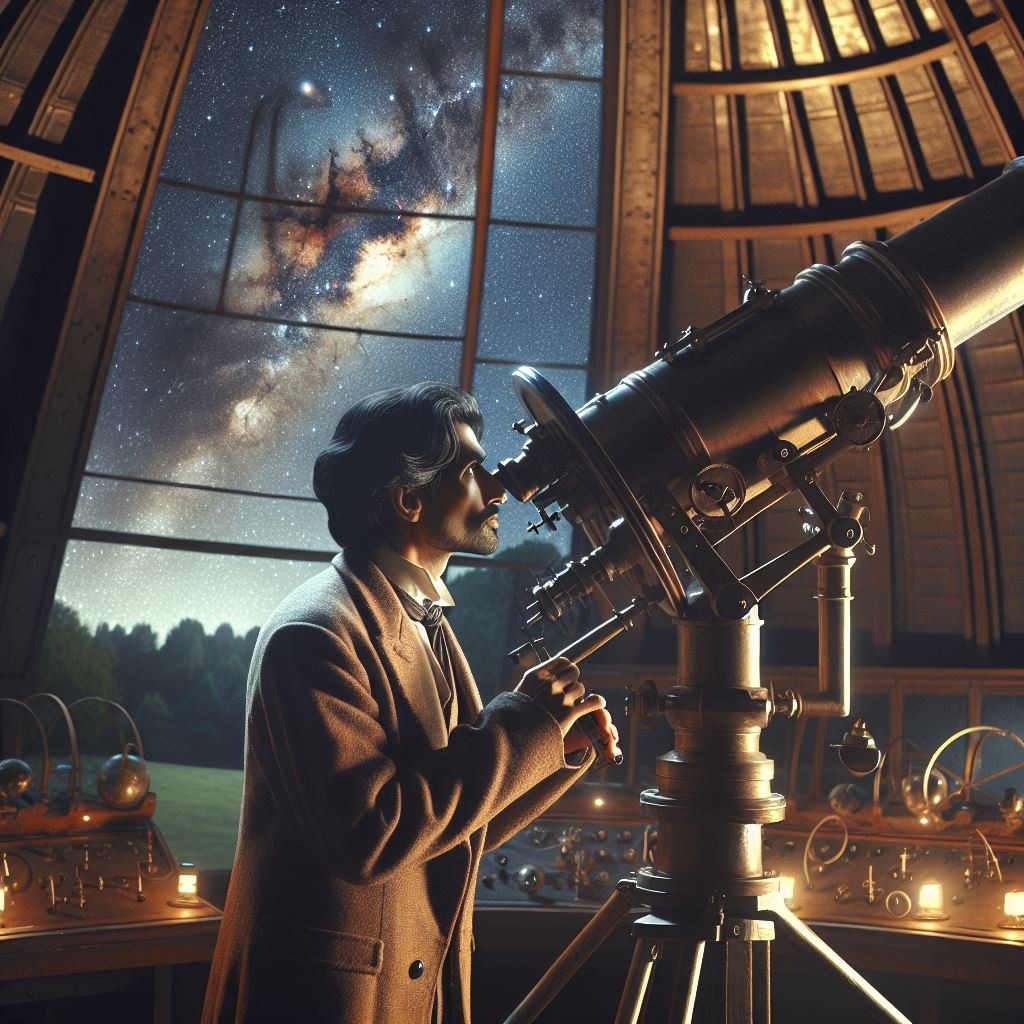
Today we celebrate the birth of Edwin Powell Hubble (20 November 1889 – 28 September 1953), one of the greatest astronomers in history. His discoveries revolutionised our understanding of the universe, expanding its boundaries far beyond the Milky Way. Among his most significant contributions are:
The Universe beyond the Milky Way: In 1923, Hubble discovered a Cepheid variable star in the Andromeda Nebula (marked “VAR!” on a photograph from that period). By measuring its distance using the relationship between its period of variability and its brightness, he concluded that Andromeda was a galaxy outside the Milky Way. This discovery ended the debate on the nature of “spiral nebulae”, proving that the Universe was much larger than previously imagined.
The expanding universe: He formulated the famous Hubble-Lemaître Law, which describes the proportionality between the speed at which galaxies are moving away from each other and their distance from the Milky Way. This law was a milestone in understanding the expansion of the universe, one of the fundamental principles of modern cosmology. From the Photo of Andromeda to Modern Telescopes The photograph taken by Edwin Hubble in 1923 represents a historic moment: confirmation that Andromeda was a galaxy in its own right. Today, thanks to technological advances, images of this calibre can be obtained with amateur telescopes, while more advanced instruments, such as the Hubble Space Telescope, offer unprecedented resolution, revealing individual stars within the Andromeda galaxy. The evolution of telescopes, from the first spyglasses to the James Webb Space Telescope, has allowed us to deepen our knowledge, pushing the boundaries of the observable universe ever further. Science continues to advance, but Edwin Hubble's contribution remains a milestone in the history of astronomy.
We've detected you might be speaking a different language. Do you want to change to:

 Italian
  English
 French
 Spanish
 German