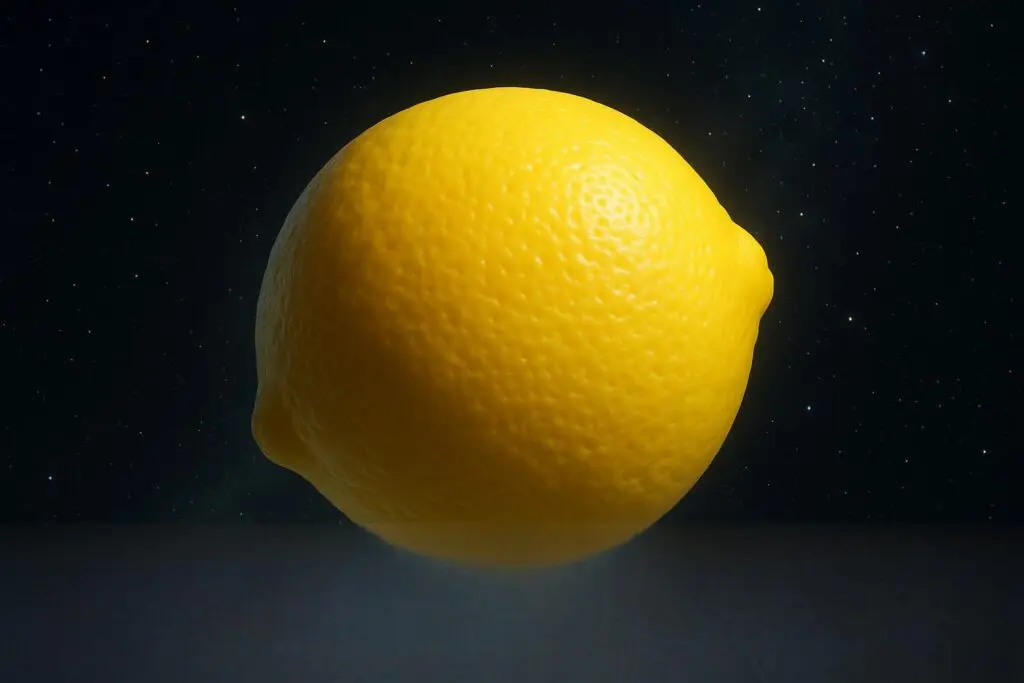
There is a world out there, about 750 light-years away from us, that seems to have come out of a stellar fairy tale: PSR J2322-2650b, an exoplanet whose shape resembles a lemon suspended in the infinite sky. This planet is not round as we would expect — it has been deformed by the titanic forces of a dying star, a pulsar that holds it in such a powerful embrace that it stretches it as if it were a fruit kissed by the cosmic wind.
But the real magic is not just in its unusual profile: it is in the atmosphere that surrounds it, a thin blanket of helium and molecular carbon (such as C₂ and C₃) that is unlike anything we have seen so far in the more than 6,000 exoplanets studied. There are no traces of water, methane or carbon dioxide as one might expect; instead, the sky of this world pulsates with pure carbon and helium light, defying all known classification.
PSR J2322-2650b's dance around its star is frenetic and passionate: it completes its orbit in just 7.8 hours, so close that it is locked in an embrace that blends gravity and celestial desire. The parent star is not a bright star like our Sun, but a pulsar, the residual heart of an exploded star that pulses at dizzying rhythms and emits rays so intense that they are perceived as a beacon in the darkness of the universe.
This intimate relationship has a surprising effect on the shape of the planet: the side that always faces the pulsar is scorching hot, while the other, in its eternal embrace with the void, remains relatively cooler — yet together they form a figure so strangely perfect that it resembles a luminous fruit suspended in the cosmos.
Guided by the infrared gaze of the James Webb Space Telescope, scientists were confronted with a sight that left them speechless: an atmosphere so peculiar that it suggested scenarios such as clouds of soot or diamond rain, transforming this planet into something more like a dream than a real world.
Yet despite its beauty and strangeness, PSR J2322-2650b remains an enigma. No one knows exactly how it was born, nor how it could have developed a composition so different from what traditional planetary formation models predict. Perhaps it was born from stellar remnants; perhaps it was shaped by forces we do not yet fully understand. In any case, this cosmic lemon invites us to look beyond known boundaries and imagine the universe not only as a place to study, but as a poem that is constantly being written.

 Italian
  English
 French
 Spanish
 German