According to a new study, our Moon is the result of an ancient cosmic encounter between the newly formed Earth and Theia, a young planet the size of Mars that had formed near the Sun.
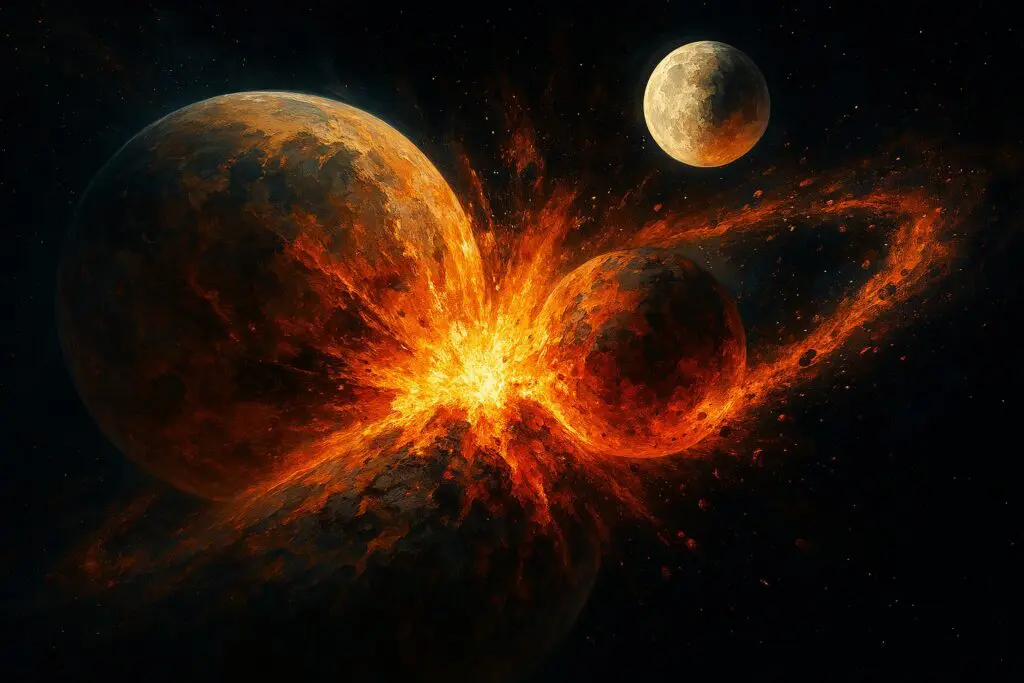
Theia, shaped by the intense light of the inner regions of the Solar System, would have embarked on a slow journey outwards, pushed and disturbed by the gravitational dance of Jupiter and Saturn. That journey led it, about 100 million years after the birth of the Solar System, to cross paths with Earth in an impact as violent as it was creative.
From that immense collision, two wounded but renewed bodies would give rise to what we are today: the Earth we know and the Moon that has accompanied us for billions of years, the silent companion of our nights.
Traces of that history are still within us: elements that should not be on Earth, reminding us of an origin closer to the Sun; iron scattered throughout the outer layers of the planet like scars from an ancient fusion.
Thus, between memory and matter, the Moon appears not as a simple satellite, but as the luminous result of a cosmic embrace that shaped our world.
We've detected you might be speaking a different language. Do you want to change to:
 Italian
  English
 French
 Spanish
 German